← BACK TO CATALOGUE A KNOWLE · FIRST EDITION · FOLIO SERIES
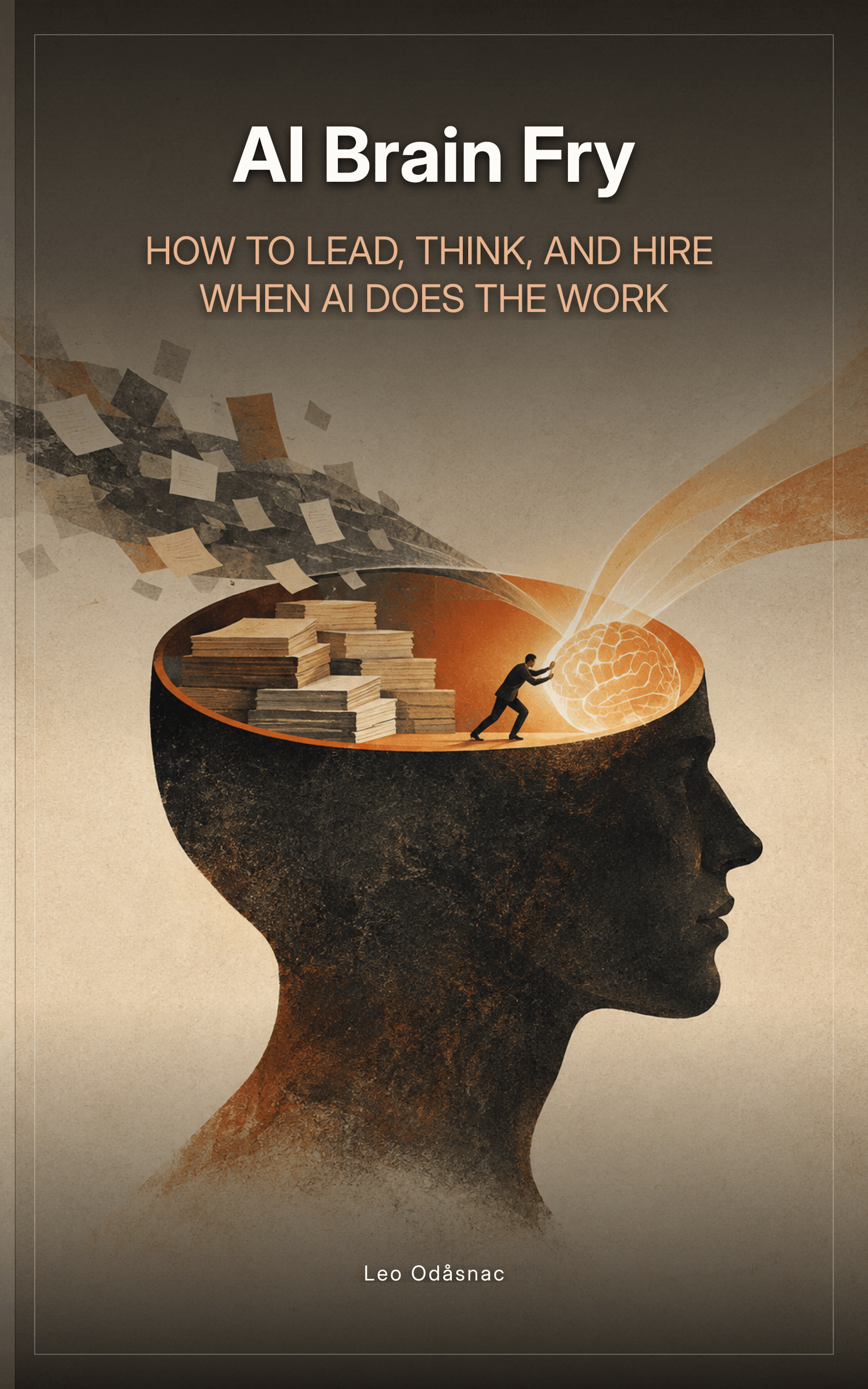
AI Brain Fry by Leo Odåsnac
FORMATS Digital (WAB) · Paperback · Kindle
DIMENSIONS 100 pages · 18,500 words · 90 min read
MONOGRAPH · VOLUME 15 — BUSINESS

AI Brain Fry

How to Lead, Think, and Hire When AI Does the Work
LO

AUTHOR

Leo Odåsnac

CURATED KNOWLEDGE FOLIO

AI can produce an answer in seconds. Understanding whether it is right still takes human attention.

That gap is where AI-assisted work can get complicated. A manager may save time drafting a briefing, then spend it checking omissions and correcting confident mistakes. A developer may receive code faster than they can judge whether it fits the system. The work looks quicker; the thinking may not be.

AI Brain Fry examines this tension without treating AI as either a miracle or a menace. Leo Odåsnac explores how AI can reduce repetitive effort while adding the work of steering, reviewing, and deciding—and why a polished answer is not the same as a sound one. The book offers practical ways to map a workflow before adding AI, match oversight to the stakes, and measure outcomes rather than the volume of generated material.

It also tackles a changing hiring challenge: how to distinguish genuine competence from a glossy deliverable. Through job-relevant exercises and structured assessment, leaders can look for problem framing, domain knowledge, independent judgment, and the ability to use AI appropriately. For individuals, the same principle applies: delegate the friction, not the understanding you need to own an important decision.

A clear-eyed guide for people who want AI to help with the work—and want to stay able to think about it.
verified Always 100% free to read online. Physical editions printed on demand on sustainably sourced unbleached paper.

The Core Argument

AI can make work faster while making the thinking around that work more demanding. This book helps you recognize when AI is reducing effort—and when it is quietly adding cognitive load—so you can design better workflows, judge AI-assisted work with confidence, hire for real competence, and use AI without surrendering your own understanding.

The Reading Path

Crafted for a single contemplative evening or two morning sittings. Each chapter functions as a self-contained mental model and immediate intervention.

FORMAT Printed Monograph & Web
LENGTH 90 Min Read
ACCESS Complete & Unrestricted
READ FIRST CHAPTER →
Chapter 1

The Productivity Paradox: More Output, More Mental Work

  • When the Assistant Becomes Another Thing to Manage
  • Fatigue Is Not Burnout
  • The Output Meter Is Not the Value Meter
Chapter 2

The Judgment Problem: Knowing Whether the Answer Is Good

  • Offloading, Attention, and Automation Bias
  • The Polished Answer and the Shallow Understanding
  • A Practical Test for Trust
Chapter 3

The Leadership Challenge: Design the Work, Not Just the Prompt

  • Map the Work Before Adding AI
  • Set Oversight That Fits the Stakes
  • Reduce Iterations; Measure the Result
Chapter 4

The New Hiring Challenge: Competence Beyond the Polished Work Sample

  • What Strong Candidates Bring to AI-Assisted Work
  • Assess the Thinking, Not Just the Deliverable
  • Warning Signs, Fairness, and Selection Evidence
Chapter 5

The Individual’s Thinking Advantage: Use AI Without Handing Over Understanding

  • Choose What to Think Through Yourself
  • Turn Answers Into Learning
  • Keep Ownership of the Important Decisions

Scholarly References

Peer-reviewed sources, field research, and primary literature grounding this monograph.

  1. World Health Organization. ICD-11, “Burn-out.” [Burn-out an occupational phenomenon](https://www.who.int/standards/classifications/frequently-asked-questions/burn-out-an-occupational-phenomenon).
  2. Boston Consulting Group. (2026, March 5). [When Using AI Leads to “Brain Fry”](https://www.bcg.com/news/5march2026-when-using-ai-leads-brain-fry).
  3. Risko, E. F., & Gilbert, S. J. (2016). Cognitive offloading. *Trends in Cognitive Sciences, 20*(9), 676–688. [https://doi.org/10.1016/j.tics.2016.07.002](https://doi.org/10.1016/j.tics.2016.07.002).
  4. Lee, H.-P., Sarkar, A., Tankelevitch, L., Drosos, I., Rintel, S., Banks, R., & Wilson, N. (2025). The impact of generative AI on critical thinking: Self-reported reductions in cognitive effort and confidence effects from a survey of knowledge workers. *Proceedings of the CHI Conference on Human Factors in Computing Systems*. [https://doi.org/10.1145/3706598.3713778](https://doi.org/10.1145/3706598.3713778).
  5. The association between AI usage and critical thinking in AI contexts: examining the mediating roles of automation bias and cognitive offloading (2026)
  6. Schmidt, F. L., & Hunter, J. E. (1998). The validity and utility of selection methods in personnel psychology: Practical and theoretical implications of 85 years of research findings. *Psychological Bulletin, 124*(2), 262–274. https://doi.org/10.1037/0033-2909.124.2.262
  7. Sackett, P. R., Zhang, C., Berry, C. M., & Lievens, F. (2022). Revisiting meta-analytic estimates of validity in personnel selection: Addressing systematic overcorrection for restriction of range. *Journal of Applied Psychology, 107*(11), 2040–2068. https://doi.org/10.1037/apl0000994

Explore More Knowles

VIEW ENTIRE LIBRARY →
AI Agents: When AI Starts Doing the Work
A KNOWLE · 90 MIN

AI Agents: When AI Starts Doing the Work

AI Agents: When AI Starts Doing the Work provides an authoritative and accessible exploration into its subject matter. Designed specificall…

INSPECT →
Chinese Grammar for Laowais
A KNOWLE · 90 MIN

Chinese Grammar for Laowais

You can tell a taxi driver where to go. But what happens when you want to say when, why, or how—and the sentence stops matching the English…

INSPECT →
OPEN FOLIO ACCESS

Begin reading "AI Brain Fry" right now.

Free unabridged edition with instant cloud bookmarking.
auto_stories OPEN WEB READER