← BACK TO CATALOGUE A KNOWLE · FIRST EDITION · FOLIO SERIES
How AI Creates Images by Leo Odåsnac
FORMATS Digital (WAB) · Paperback · Kindle
DIMENSIONS 100 pages · 18,500 words · 90 min read
MONOGRAPH · VOLUME 14 — TECHNOLOGY

How AI Creates Images

From Random Noise to Remarkable Pictures — Understanding the Technology Behind Generative AI
LO

AUTHOR

Leo Odåsnac

CURATED KNOWLEDGE FOLIO

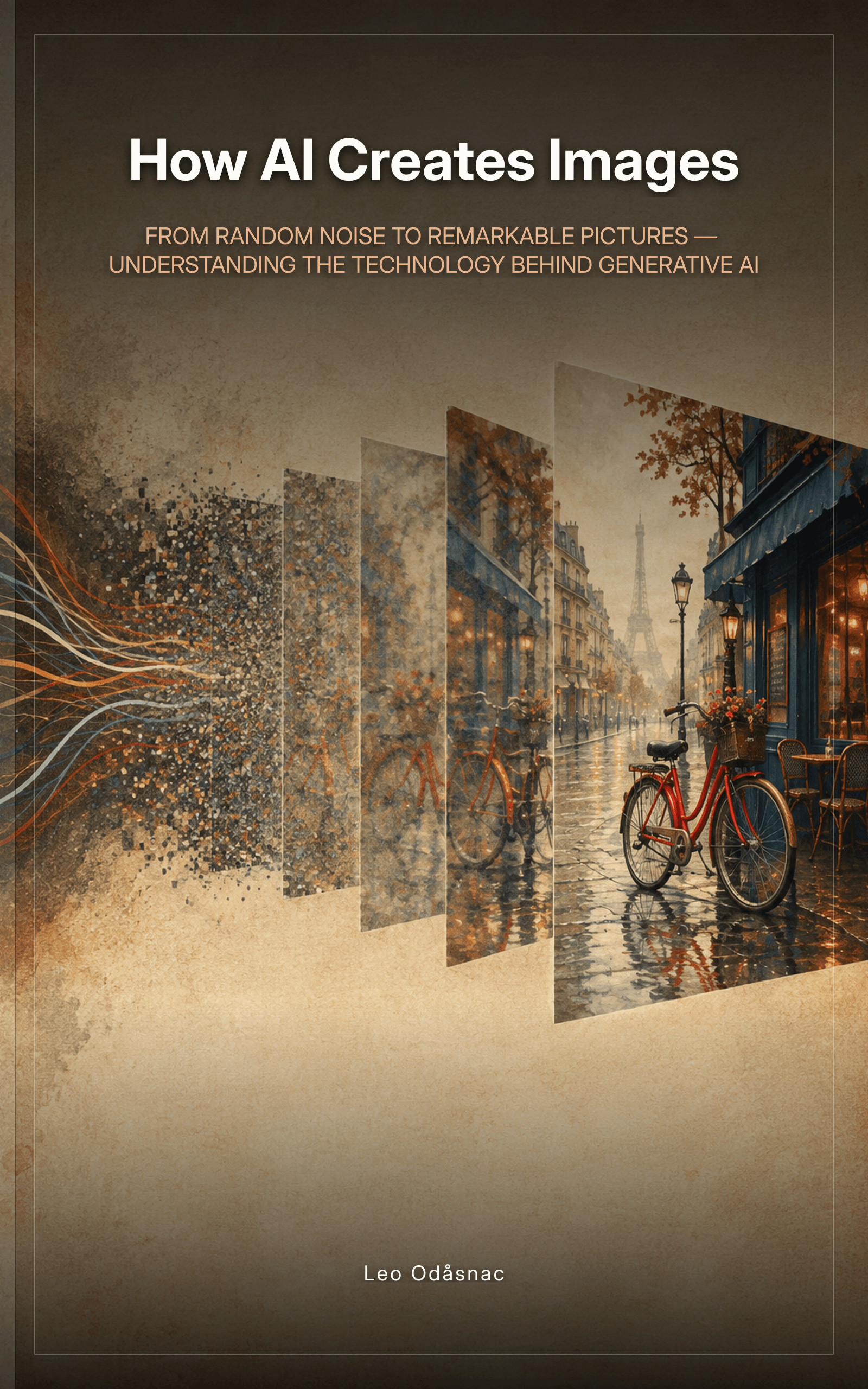
How can a picture emerge from random noise—and why might it still get a bicycle’s wheels wrong?

Text-to-image AI can make a rainy Parisian street feel almost photographic. But that does not mean the system searched for the right picture or understood the scene as a person would. It learned patterns from images and associated text, then used those patterns to generate a new arrangement.

In How AI Creates Images, Leo Odåsnac follows one scene—a red bicycle outside a blue café—to explain the process from training to pixels. The central idea is diffusion: a model learns to reverse the progressive corruption of images, then uses that ability to move from noise toward an image guided by a prompt. Along the way, discover how words become numerical signals, how compressed visual representations can be decoded into pixels, and why changing the prompt or random seed can change the result.

The book also looks at where generation stumbles: counting, placement, physical plausibility, and words rendered inside an image. It distinguishes diffusion from autoregressive and flow-based approaches, and briefly connects image generation to language, video, and music.

This is an explanation of the technology, not a prompt-writing manual. Read it to replace the magic with a clear mental model—and to understand both what these systems can make and what they can get wrong.
verified Always 100% free to read online. Physical editions printed on demand on sustainably sourced unbleached paper.

The Core Argument

Follow a red bicycle onto a rainy Parisian street and discover how a model learns visual patterns, turns words into guidance, and transforms noise into a new image. You’ll leave with a clear mental model of diffusion and its alternatives, why generated pictures can be convincing yet flawed, and how related ideas power language, music, and video generation.

The Reading Path

Crafted for a single contemplative evening or two morning sittings. Each chapter functions as a self-contained mental model and immediate intervention.

FORMAT Printed Monograph & Web
LENGTH 90 Min Read
ACCESS Complete & Unrestricted
READ FIRST CHAPTER →
Chapter 1

What a Model Learns from Images

  • Learning from Pictures and Their Captions
  • Patterns, Objects, and Composition
  • Why Generation Is Not Photo Search
Chapter 2

The Diffusion Idea: Learning to Undo Noise

  • Corrupting an Image on Purpose
  • Learning the Reverse Journey
  • Starting with Noise, Creating Something New
Chapter 3

How Words Guide the Picture

  • Turning a Prompt into a Guide
  • Attention and the Link between Words and Visual Features
  • Latent Space: Building Before Rendering
  • Following One Image from Prompt to Pixels
Chapter 4

Convincing Pictures, Imperfect Understanding

  • When the Scene Looks Right at First
  • Counting, Placement, and Physical Plausibility
  • Words in the Image and Words in the Prompt
Chapter 5

Image Generation in the Generative AI Family

  • Next-Token Prediction and Iterative Denoising
  • Flow Matching and Other Routes to an Image
  • Why the Breakthroughs Arrived Together
Chapter 6

From Still Images to Moving and Sounding Worlds

  • What Video Adds: Motion and Continuity
  • What Music Adds: Rhythm and Sonic Structure
  • A Simple Explanation to Carry Forward

Scholarly References

Peer-reviewed sources, field research, and primary literature grounding this monograph.

  1. Nicholas Carlini et al. *Extracting Training Data from Diffusion Models*. 2023. [arXiv:2301.13188](https://arxiv.org/abs/2301.13188).
  2. Jonathan Ho, Ajay Jain, Pieter Abbeel. *Denoising Diffusion Probabilistic Models*. 2020. [arXiv:2006.11239](https://arxiv.org/abs/2006.11239).
  3. Research on temporal consistency animation video generation method based on grid convolution (2026)
  4. Mechanistic Interpretability of Text-to-Image Diffusion Models via Cross-Attention Interventions (2026)
  5. Jonathan Ho, Tim Salimans. *Classifier-Free Diffusion Guidance*. 2022; workshop version 2021. [arXiv:2207.12598](https://arxiv.org/abs/2207.12598).
  6. Yaron Lipman, Ricky T. Q. Chen, Heli Ben-Hamu, Maximilian Nickel, Matt Le. *Flow Matching for Generative Modeling*. 2022; revised 2023. [arXiv:2210.02747](https://arxiv.org/abs/2210.02747).
  7. Aditya Ramesh et al. *Zero-Shot Text-to-Image Generation*. 2021. [arXiv:2102.12092](https://arxiv.org/abs/2102.12092).
  8. William Peebles, Saining Xie. *Scalable Diffusion Models with Transformers*. 2022; revised 2023. [arXiv:2212.09748](https://arxiv.org/abs/2212.09748).
  9. Jonathan Ho et al. *Video Diffusion Models*. 2022. [arXiv:2204.03458](https://arxiv.org/abs/2204.03458).
  10. Jade Copet et al. *Simple and Controllable Music Generation*. 2023; revised 2024. [arXiv:2306.05284](https://arxiv.org/abs/2306.05284).
  11. Zach Evans et al. *Stable Audio Open*. 2024. [arXiv:2407.14358](https://arxiv.org/abs/2407.14358).
  12. Wave Function Collapse Meets Diffusion and Flow Matching (2026)

Explore More Knowles

VIEW ENTIRE LIBRARY →
AI Agents: When AI Starts Doing the Work
A KNOWLE · 90 MIN

AI Agents: When AI Starts Doing the Work

AI Agents: When AI Starts Doing the Work provides an authoritative and accessible exploration into its subject matter. Designed specificall…

INSPECT →
Chinese Grammar for Laowais
A KNOWLE · 90 MIN

Chinese Grammar for Laowais

You can tell a taxi driver where to go. But what happens when you want to say when, why, or how—and the sentence stops matching the English…

INSPECT →
OPEN FOLIO ACCESS

Begin reading "How AI Creates Images" right now.

Free unabridged edition with instant cloud bookmarking.
auto_stories OPEN WEB READER