← BACK TO CATALOGUE A KNOWLE · FIRST EDITION · FOLIO SERIES
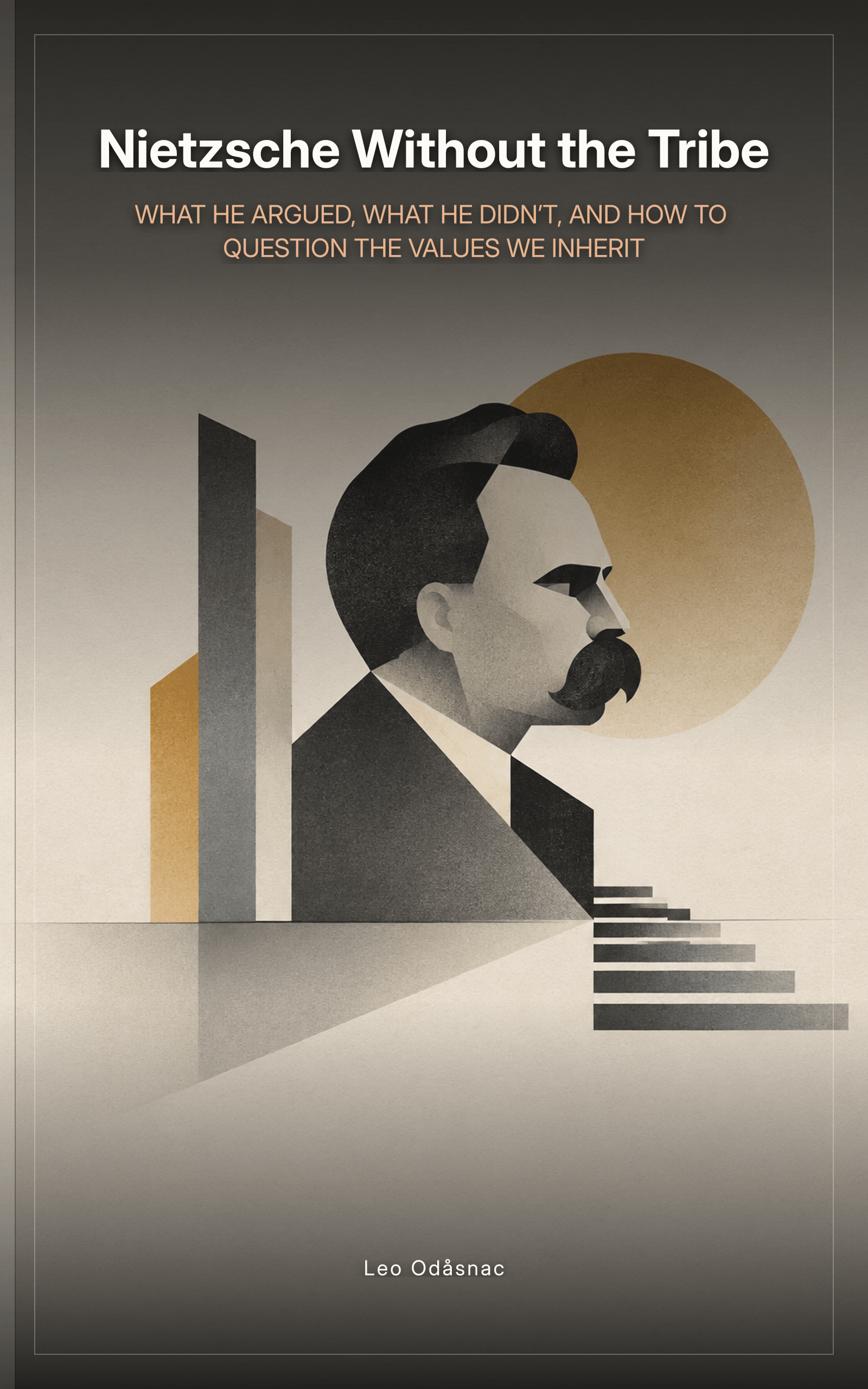
Nietzsche Without the Tribe by Leo Odåsnac
FORMATS Digital (WAB) · Paperback · Kindle
DIMENSIONS 100 pages · 18,500 words · 90 min read
MONOGRAPH · VOLUME 05 — THINKING

Nietzsche Without the Tribe

What He Argued, What He Didn’t, and How to Question the Values We Inherit
LO

AUTHOR

Leo Odåsnac

CURATED KNOWLEDGE FOLIO
What He Argued, What He Didn’t, and How to Question the Values We Inherit

verified Always 100% free to read online. Physical editions printed on demand on sustainably sourced unbleached paper.
The Core Argument

Meet Nietzsche neither as a mascot nor a villain, but as a brilliant, troubling thinker who asks where our values come from and what happens when old sources of meaning lose their force. This clear-eyed primer separates his arguments from familiar caricatures and later political uses, then helps you examine which convictions you have truly chosen—and which your tribe chose for you.

The Reading Path

Crafted for a single contemplative evening or two morning sittings. Each chapter functions as a self-contained mental model and immediate intervention.

FORMAT Printed Monograph & Web
LENGTH 90 Min Read
ACCESS Complete & Unrestricted
READ FIRST CHAPTER →
Chapter 1

Start with the Question, Not the Slogan

  • A Philosopher Who Asks Where Values Come From
  • What Does This Belief Do to Us?
  • Read the Books, Not Just the Catchphrases
Chapter 2

The sentence is not always the argument

  • The sentence is not always the argument
Chapter 3

Published books and private notebooks

  • Published books and private notebooks
Chapter 4
Chapter 5

The announcement and its audience

  • The Emptiness That Follows an Old Answer
  • Why Replacing Belief Is Harder Than Rejecting It
  • The seduction of ready-made replacements
  • Diagnosis is not a cure
Chapter 6

Values Under Examination

  • A Genealogy of Good and Bad
  • Two histories of “good”
  • The change from “bad” to “evil”
  • A history to test, not a verdict to inherit
  • Suspicion Is a Beginning, Not a Verdict
  • The Herd, the Crowd, and the Comfort of Agreement
Chapter 7

Self-Overcoming Without the Self-Help Slogan

  • The Übermensch: An Ideal, Not a Superhero
  • Will to Power: More Than Winning
  • Creating Values Is Not Making Up Excuses
Chapter 8

Nietzsche in the Political Crossfire

  • A Thinker Claimed by Opposing Camps
  • The text, the selection, the appropriation
  • What His Critique of Equality Does—and Does Not—Say
Chapter 9

Equality as a moral ideal—and as a leveling force

  • Equality as a moral ideal—and as a leveling force
Chapter 10

What follows—and what does not

  • Tribes Then and Now: Use the Analogy Carefully
Chapter 11

A Nietzschean Reflex for a Noisy Age

  • Follow the Value Back to Its Source
  • Ask What Kind of Person It Encourages You to Become
Chapter 12

What a Value Trains You to Notice

  • What a Value Trains You to Notice
Chapter 13

Follow the Effects, Not Just the Slogan

  • Follow the Effects, Not Just the Slogan
Chapter 14

The Uncomfortable Counterfactual

  • Choose Without Pretending to Be Above the Crowd

Scholarly References

Peer-reviewed sources, field research, and primary literature grounding this monograph.

  1. Friedrich Nietzsche, *On the Genealogy of Morality* (1887), Preface §§3 and 6. Available as *The Genealogy of Morals*, translated by Horace B. Samuel: [Project Gutenberg](https://www.gutenberg.org/files/52319/52319-h/52319-h.htm).
  2. Nietzsche, *Beyond Good and Evil* (1886), §§1 and 4, translated by Helen Zimmern: [Project Gutenberg](https://www.gutenberg.org/files/4363/4363-h/4363-h.htm).
  3. R. Lanier Anderson, “Friedrich Nietzsche,” *Stanford Encyclopedia of Philosophy*, §1, on the notebooks and editorial construction of *The Will to Power*: [entry](https://plato.stanford.edu/entries/nietzsche/). A posthumous publication date alone does not make a work a notebook compilation; the distinction concerns how the text was prepared and assembled.
  4. Nietzsche, *The Gay Science* (1882; expanded 1887), §§125 and 343. Available as *The Joyful Wisdom*, translated by Thomas Common: [Project Gutenberg](https://www.gutenberg.org/files/52124/52124-h/52124-h.htm). “God is dead” is a direct quotation; the account of the scenes and their implications is paraphrase and interpretation.
  5. Nietzsche, *On the Genealogy of Morality*, III §§13 and 28, on the ascetic ideal’s preservation of willing and its hostility to life: [Samuel translation](https://www.gutenberg.org/files/52319/52319-h/52319-h.htm).
  6. 김바다. *Reconsideration of Nietzsche’s On the Genealogy of Morality - Focusing on the First Essay and the Second Essay of On the Genealogy of Morality*. The Journal of Korean Nietzsche-Society, 2013. [https://doi.org/10.16982/jkns.2013..24.008](https://doi.org/10.16982/jkns.2013..24.008) (accessed 2026-10-11).
  7. Nietzsche, *On the Genealogy of Morality*, I §§2, 7, 10–13, on noble valuation, the priestly reversal, and *ressentiment*: [Samuel translation](https://www.gutenberg.org/files/52319/52319-h/52319-h.htm), which renders *ressentiment* as “resentment.” See also the secondary discussion in note 1.
  8. Nietzsche, *Thus Spoke Zarathustra* (1883–1885), Prologue §§3–5 and Part II, “On Self-Overcoming.” Available as *Thus Spake Zarathustra*, translated by Thomas Common, whose chapter title is “Self-Surpassing”: [Project Gutenberg](https://www.gutenberg.org/files/1998/1998-h/1998-h.htm). Consult Nietzsche’s text rather than treating the edition’s historical introduction or appended commentary as his words.
  9. Nietzsche, *Beyond Good and Evil*, §§258–259: [Zimmern translation](https://www.gutenberg.org/files/4363/4363-h/4363-h.htm). These passages directly support the discussion of aristocratic sacrifice and exploitation; the musician example is a modern illustration, not Nietzsche’s example or a complete definition of will to power. For competing interpretations, see Anderson, “Friedrich Nietzsche,” §6.1: [Stanford Encyclopedia of Philosophy](https://plato.stanford.edu/entries/nietzsche/#WillPowe).
  10. Nietzsche, *The Gay Science*, §§276 and 341: [Common translation](https://www.gutenberg.org/files/52124/52124-h/52124-h.htm). The demon’s challenge is paraphrased here. On interpretive disputes about eternal recurrence, see Anderson, “Friedrich Nietzsche,” §6.3: [Stanford Encyclopedia of Philosophy](https://plato.stanford.edu/entries/nietzsche/).
  11. Nietzsche, *Beyond Good and Evil*, §251: [Zimmern translation](https://www.gutenberg.org/files/4363/4363-h/4363-h.htm); *The Gay Science*, §377: [Common translation](https://www.gutenberg.org/files/52124/52124-h/52124-h.htm). His opposition to antisemitic movements should be read alongside, not substituted for, scrutiny of his language about peoples and races.
  12. Klassik Stiftung Weimar, “Nietzsche im Nationalsozialismus,” exhibition account of the Nietzsche Archive’s role in political appropriation: [exhibition](https://www.klassik-stiftung.de/ihr-besuch/ausstellung/nietzsche-im-nationalsozialismus/). See also Anderson, “Friedrich Nietzsche,” §1, cited in note 4, for the editorial history of the notebooks.
  13. Nietzsche, *Beyond Good and Evil*, §§201–202: [Zimmern translation](https://www.gutenberg.org/files/4363/4363-h/4363-h.htm).

Explore More Knowles

VIEW ENTIRE LIBRARY →
AI Agents: When AI Starts Doing the Work
A KNOWLE · 90 MIN

AI Agents: When AI Starts Doing the Work

AI Agents: When AI Starts Doing the Work provides an authoritative and accessible exploration into its subject matter. Designed specificall…

INSPECT →
How AI Really Works
A KNOWLE · 90 MIN

How AI Really Works

From Prediction to Reasoning: What Happens Inside an LLM When It Learns, Answers, and Thinks

INSPECT →
OPEN FOLIO ACCESS

Begin reading "Nietzsche Without the Tribe" right now.

Free unabridged edition with instant cloud bookmarking.
auto_stories OPEN WEB READER