← BACK TO CATALOGUE A KNOWLE · FIRST EDITION · FOLIO SERIES
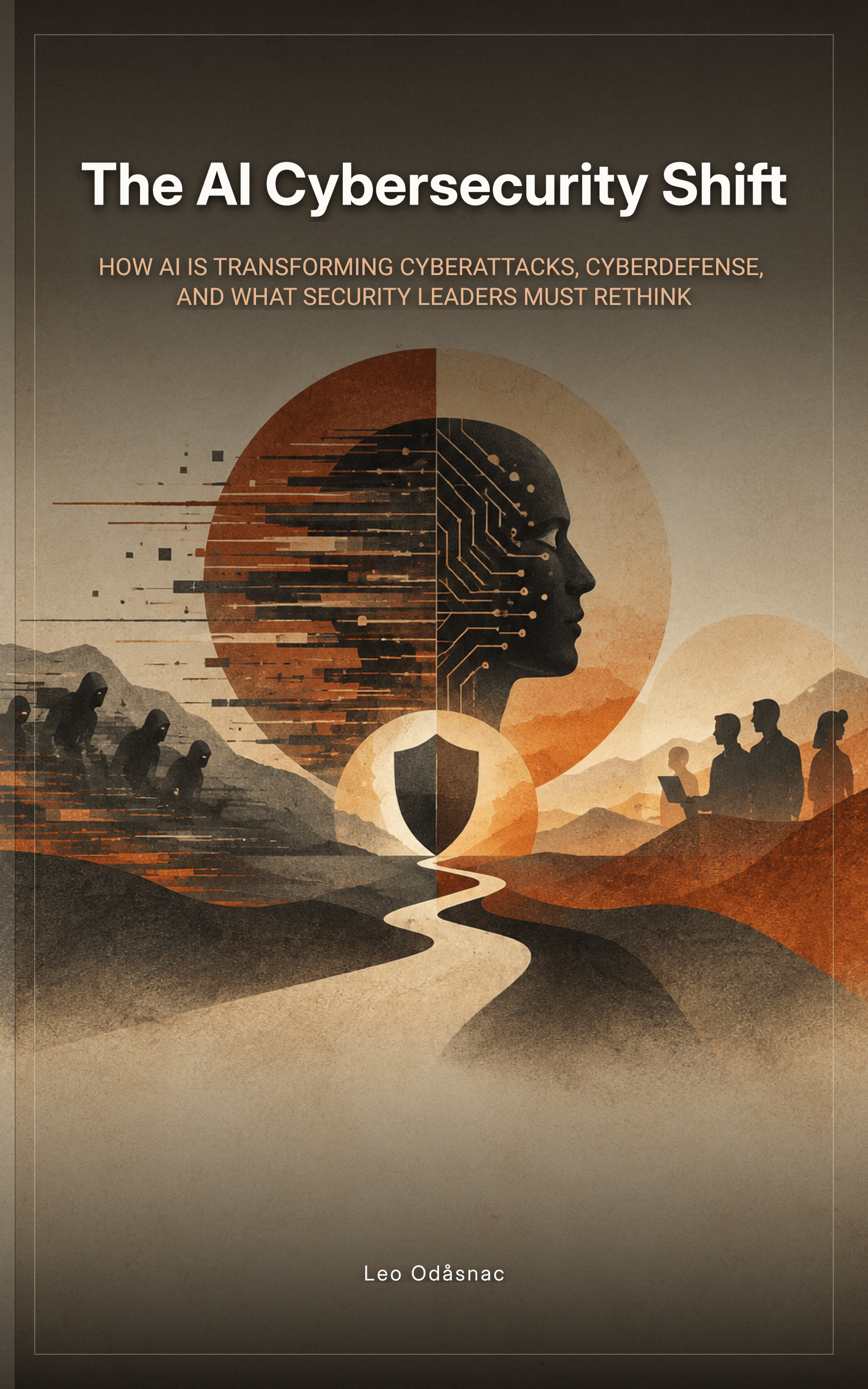
The AI Cybersecurity Shift by Leo Odasnac
FORMATS Digital (WAB) · Paperback · Kindle
DIMENSIONS 100 pages · 18,500 words · 90 min read
MONOGRAPH · VOLUME 08 — TECHNOLOGY

The AI Cybersecurity Shift

How AI is Transforming Cyberattacks, Cyberdefense, and What Security Leaders Must Rethink
LO

AUTHOR

Leo Odasnac

CURATED KNOWLEDGE FOLIO

AI can help draft a convincing message, summarize an alert, or act through a connected tool. Those are not the same capability—and they do not carry the same risk.

For security leaders, the challenge is to make sound decisions amid claims that can blur assistance with autonomy, a successful demonstration with real-world impact, and faster work with better security. The AI Cybersecurity Shift offers a grounded way to tell what is changing, what is being amplified, and what evidence can support a response.

The book examines three connected questions: how AI may assist attackers, where it can help defenders, and what new risks arise when an organization’s own AI systems can reach data and take action. Its practical lens asks what task is delegated, where the human fits, how much authority the system has, what measurably changes, and what happens when it is wrong.

Explore why fluent output is not verification, why AI-assisted triage still needs evidence, and why an agent’s identity, permissions, connectors, and data paths matter. The aim is not another threat catalogue or product comparison, but a sharper way to assess claims and revisit architecture without discarding proven security fundamentals.

For CISOs and security professionals who need to explain the shift—and decide what to ask next.
verified Always 100% free to read online. Physical editions printed on demand on sustainably sourced unbleached paper.

The Core Argument

Build a clear-eyed mental model of what AI genuinely changes in cybersecurity, what it merely amplifies, and where evidence remains uncertain. You’ll learn how to weigh AI-assisted attacks and defenses, secure enterprise AI agents, and ask sharper questions about architecture, operations, governance, and accountability.

The Reading Path

Crafted for a single contemplative evening or two morning sittings. Each chapter functions as a self-contained mental model and immediate intervention.

FORMAT Printed Monograph & Web
LENGTH 90 Min Read
ACCESS Complete & Unrestricted
READ FIRST CHAPTER →
Chapter 0
Chapter 1

The New Cybersecurity Equation

  • What AI Changes—and What It Does Not
  • A Better Lens Than Hype
  • Delegated Work, New Consequences
Chapter 2

AI Against You: The Faster Adversary

  • From Reconnaissance to Persuasion
  • Finding and Exploiting Weaknesses
  • Automation and the Limits of Autonomy
  • Evidence, Uncertainty, and the Attacker’s Advantage
Chapter 3

AI for You: A More Capable Defense

  • Making Security Information Useful
  • Prioritization, Detection, and Investigation
  • Response at Machine Speed, with Human Control
  • Measuring the Defense Dividend
Chapter 4

Your AI: Securing Systems That Can Act

  • The New Trust Boundary
  • Prompt Injection and Tool Misuse
  • Identity, Permissions, and Data Exposure
  • Designing for Failure and Recovery
Chapter 5

The Security Leader’s Next Moves

  • Revisit the Architecture, Not the Fundamentals
  • Choose Investments by Risk and Evidence
  • Governance, Accountability, and Talent
  • Questions for the Executive Team and Board

Scholarly References

Peer-reviewed sources, field research, and primary literature grounding this monograph.

  1. Google Threat Intelligence Group. *Adversarial Misuse of Generative AI*. January 29, 2025. [Report](https://cloud.google.com/blog/topics/threat-intelligence/adversarial-misuse-generative-ai) (accessed 2026-10-30).
  2. The Principles of Scientific Management (1911)
  3. Google Threat Intelligence Group. *GTIG AI Threat Tracker: From Prompting to Autonomy – The Evolution of Adversarial AI*. September 8, 2026. [Report](https://cloud.google.com/blog/topics/threat-intelligence/from-prompting-to-autonomy-the-evolution-of-adversarial-ai) (accessed 2026-10-30).
  4. NIST. *Artificial Intelligence Risk Management Framework (AI RMF 1.0)*, January 2023, and *Generative Artificial Intelligence Profile*, July 2024. [Framework and profile](https://www.nist.gov/itl/ai-risk-management-framework) (accessed 2026-10-30).
  5. REDUCING SOC ANALYST ALERT FATIGUE THROUGH LLM-ASSISTED TRIAGE: A PROVIDER-AGNOSTIC SUMMARIZATION PIPELINE FOR WAZUH (2026)
  6. OWASP Gen AI Security Project. *LLM01:2025 Prompt Injection*. [Guidance](https://genai.owasp.org/llmrisk/llm01-prompt-injection/) (accessed 2026-10-30).
  7. Microsoft. *Agent identities, service principals, and applications*. Microsoft Entra Agent ID documentation. [Documentation](https://learn.microsoft.com/en-us/entra/agent-id/agent-service-principals) (accessed 2026-10-30).

Explore More Knowles

VIEW ENTIRE LIBRARY →
AI Agents: When AI Starts Doing the Work
A KNOWLE · 90 MIN

AI Agents: When AI Starts Doing the Work

AI Agents: When AI Starts Doing the Work provides an authoritative and accessible exploration into its subject matter. Designed specificall…

INSPECT →
Chinese Grammar for Laowais
A KNOWLE · 90 MIN

Chinese Grammar for Laowais

You can tell a taxi driver where to go. But what happens when you want to say when, why, or how—and the sentence stops matching the English…

INSPECT →
OPEN FOLIO ACCESS

Begin reading "The AI Cybersecurity Shift" right now.

Free unabridged edition with instant cloud bookmarking.
auto_stories OPEN WEB READER