← BACK TO CATALOGUE A KNOWLE · FIRST EDITION · FOLIO SERIES
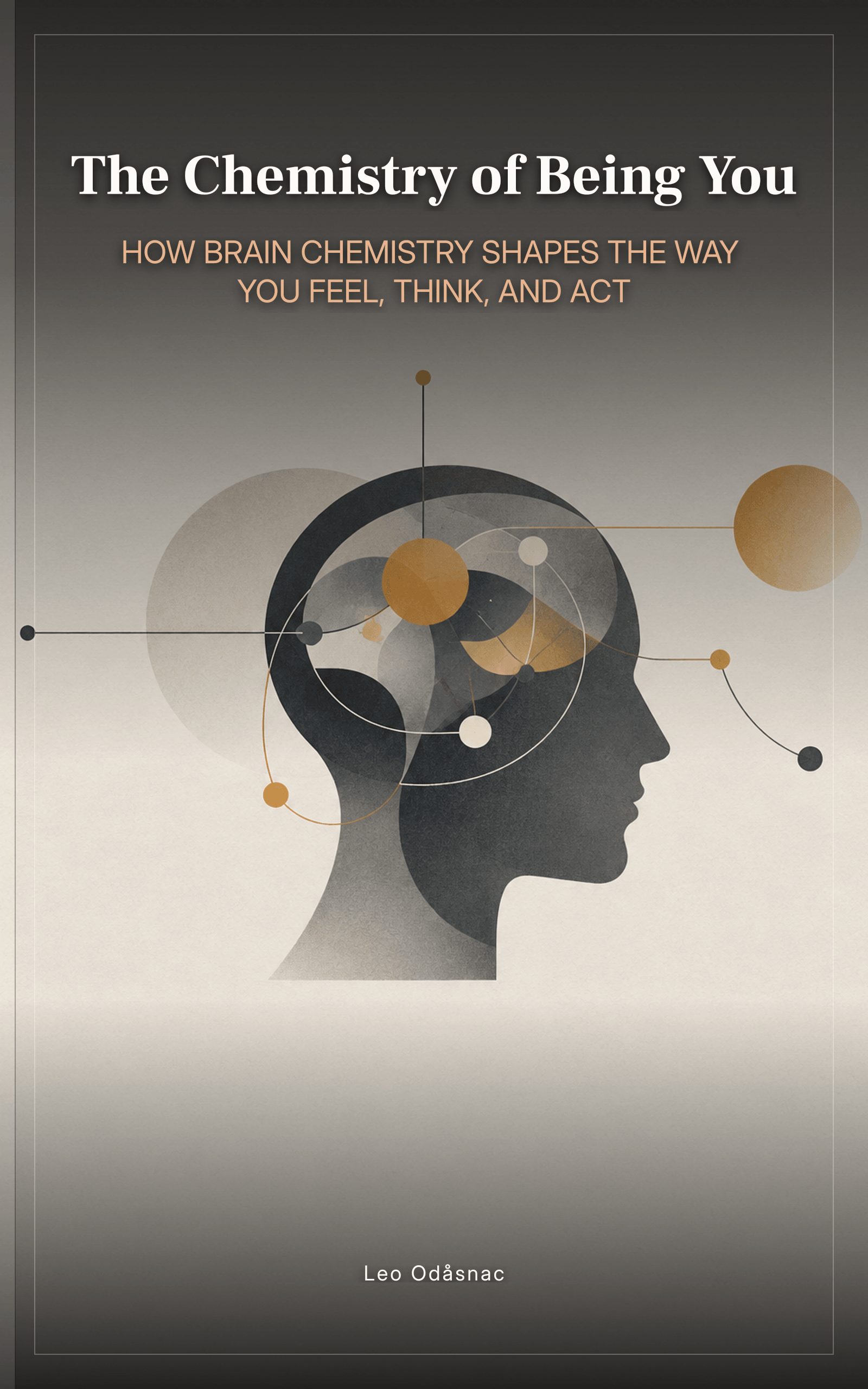
The Chemistry of Being You by Leo Odåsnac
FORMATS Digital (WAB) · Paperback · Kindle
DIMENSIONS 100 pages · 18,500 words · 90 min read
MONOGRAPH · VOLUME 13 — SCIENCE

The Chemistry of Being You

How Brain Chemistry Shapes the Way You Feel, Think, and Act
LO

AUTHOR

Leo Odåsnac

CURATED KNOWLEDGE FOLIO

You can feel pulled toward a notification and still find little pleasure in opening it. That gap between wanting and liking is one clue to why brain chemistry is more interesting—and less simple—than the familiar labels suggest.

Dopamine is not merely the pleasure chemical. Serotonin is not a happiness gauge. Cortisol is not automatically harmful. In The Chemistry of Being You, Leo Odåsnac offers a clear introduction to the chemical communication behind familiar experiences, from motivation and distraction to stress, learning, exercise, and sleep.

Start with the basic relay: electrical activity travels through neurons, chemical messengers cross synapses, and receptors shape how receiving cells respond. Then follow the signals into wider systems. You’ll see how dopamine contributes to prediction and pursuit, how noradrenaline helps tune alertness, why glutamate and GABA help shape circuit activity, and how hormones connect brain and body. The same messenger can contribute to different outcomes depending on its circuit and context.

This is not a guide to diagnosing your brain or manipulating neurotransmitter levels. It is a practical mental map for understanding what chemical signals contribute—and what a feeling alone cannot tell you. Read it to make better sense of your everyday experience, without reducing yourself to a chemical label.
verified Always 100% free to read online. Physical editions printed on demand on sustainably sourced unbleached paper.

The Core Argument

Discover how neurons, chemical signals, and interacting brain systems contribute to everyday experience, without reducing emotions to simple chemical switches. You’ll gain a practical, scientifically grounded way to understand what influences your brain—and what you can and cannot infer from how you feel.

The Reading Path

Crafted for a single contemplative evening or two morning sittings. Each chapter functions as a self-contained mental model and immediate intervention.

FORMAT Printed Monograph & Web
LENGTH 90 Min Read
ACCESS Complete & Unrestricted
READ FIRST CHAPTER →
Chapter 1

Your Brain Is Always Communicating

  • From a Familiar Feeling to a Brain Signal
  • Neurons, Messages, and Synapses
  • Local Messages, Wider Signals
  • The Limits of the Communication-Network Metaphor
Chapter 2

Meet the Messengers Behind Everyday Life

  • Dopamine and the Pull of Possibility
  • Serotonin, Noradrenaline, and Brain State
  • Glutamate, GABA, and the Balance of Activity
  • Acetylcholine, Endorphins, Oxytocin, Cortisol, and Melatonin
Chapter 3

Why One Chemical Never Tells the Whole Story

  • The Same Messenger, Different Results
  • Circuits, Feedback, and Changing Brain States
  • Three Popular Stories to Retire
  • Chemistry Is One Level of Explanation
Chapter 4

Reading Everyday Experiences Without Guessing at Chemicals

  • Motivation, Rewards, and Distraction
  • Stress Before the Important Moment
  • Learning, Habits, and the Satisfaction of Progress
  • Exercise, Social Connection, and Feeling Calmer
  • Alertness, Tiredness, and Sleep Timing
Chapter 5

What You Can Do With This Knowledge

  • Notice Patterns, Not Chemical Levels
  • Separate Strong Findings from Speculation
  • Create Better Conditions, Not Chemical Shortcuts
  • A Durable Map of the Chemistry of Being You

Scholarly References

Peer-reviewed sources, field research, and primary literature grounding this monograph.

  1. GABA <sub>B</sub> receptor-mediated potentiation of ventral medial habenula glutamatergic transmission in GABAergic and glutamatergic interpeduncular nucleus neurons (2025)
  2. Habituation of sympathetic-adrenal medullary responses following exposure to chronic intermittent stress (1989)
  3. Endogenous opioids mediate stress-induced analgesia (2018)
  4. National Institute of Mental Health. “Molecular Imaging Branch.” Describes PET and magnetic resonance spectroscopy approaches to studying brain chemistry and neurotransmitter systems. [Read source](https://www.nimh.nih.gov/research/research-conducted-at-nimh/research-areas/clinics-and-labs/mib/molecular-imaging-branch-mib)

Explore More Knowles

VIEW ENTIRE LIBRARY →
AI Agents: When AI Starts Doing the Work
A KNOWLE · 90 MIN

AI Agents: When AI Starts Doing the Work

AI Agents: When AI Starts Doing the Work provides an authoritative and accessible exploration into its subject matter. Designed specificall…

INSPECT →
Chinese Grammar for Laowais
A KNOWLE · 90 MIN

Chinese Grammar for Laowais

You can tell a taxi driver where to go. But what happens when you want to say when, why, or how—and the sentence stops matching the English…

INSPECT →
OPEN FOLIO ACCESS

Begin reading "The Chemistry of Being You" right now.

Free unabridged edition with instant cloud bookmarking.
auto_stories OPEN WEB READER