← BACK TO CATALOGUE A KNOWLE · FIRST EDITION · FOLIO SERIES
The Science of Placebo by Leo Odåsnac
FORMATS Digital (WAB) · Paperback · Kindle
DIMENSIONS 100 pages · 18,500 words · 90 min read
MONOGRAPH · VOLUME 09 — PSYCHOLOGY

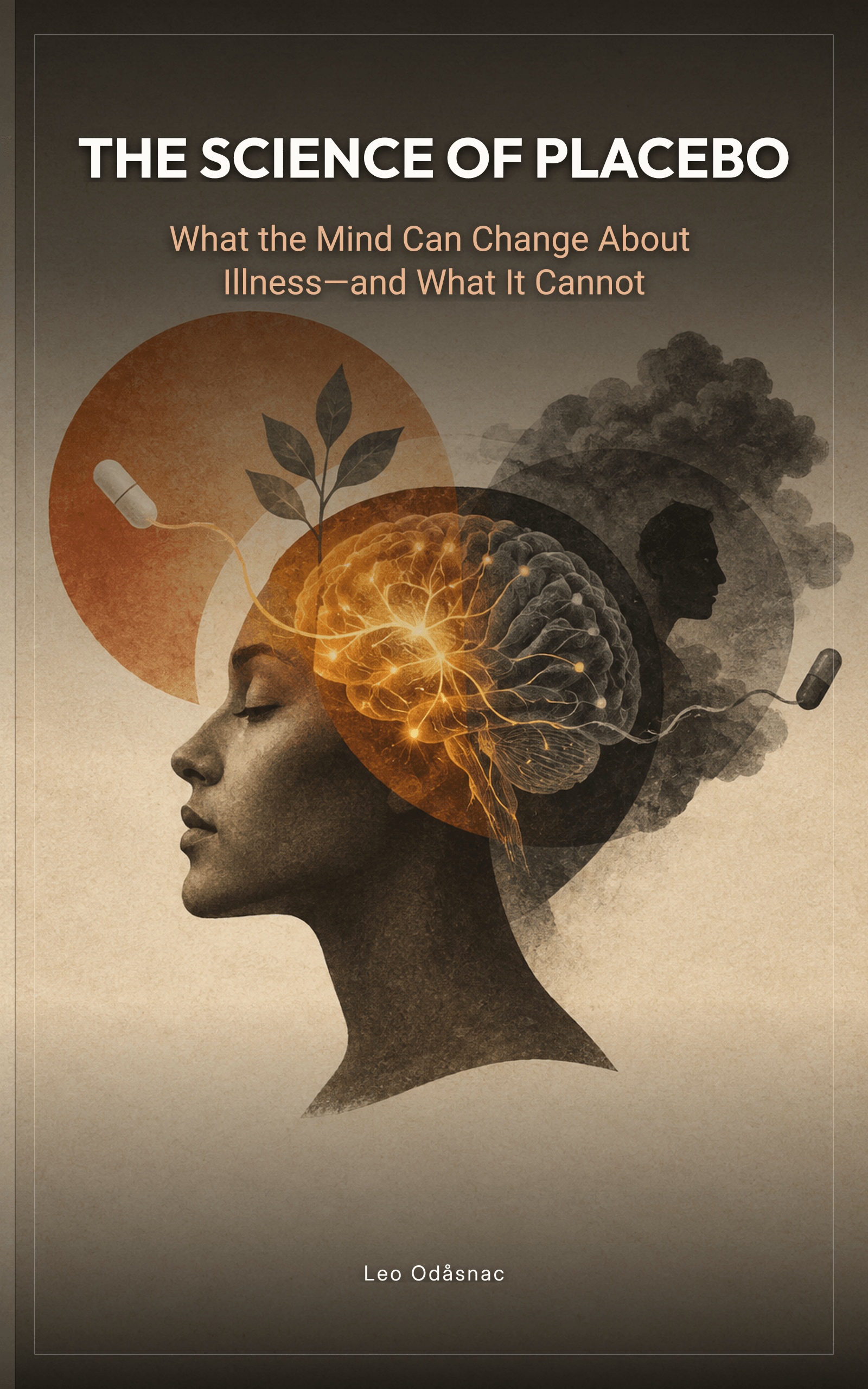
The Science of Placebo

What the Mind Can Change About Illness—and What It Cannot
LO

AUTHOR

Leo Odåsnac

CURATED KNOWLEDGE FOLIO

Can your mind change how your body feels—even when the treatment itself does nothing?

The placebo effect is one of medicine’s most fascinating discoveries. Expectations can reduce pain, ease nausea, and influence how we experience illness. But how does it actually work? And where does the power of the mind end?

In The Science of Placebo, discover the surprising neuroscience behind placebo and nocebo effects—how belief, expectation, and the brain’s own chemistry can shape symptoms, why fear can sometimes make us feel worse, and how the words of a doctor can influence the experience of treatment.

Drawing on scientific research and real-world examples, this accessible guide reveals:

  • Why placebo effects are real biological phenomena—not imaginary healing.

  • How the brain uses expectations, learning, and natural pain-relief systems to influence symptoms.

  • Why negative expectations can trigger genuine side effects through the nocebo effect.

  • How to harness the benefits of positive expectations without falling for false medical promises.

The mind cannot cure everything. But understanding how it influences the body can change the way you experience healthcare.

A fascinating, evidence-based introduction to the mind-body connection, for anyone curious about neuroscience, psychology, medicine, and the science of healing.
verified Always 100% free to read online. Physical editions printed on demand on sustainably sourced unbleached paper.

The Core Argument

Discover how belief and expectation can alter symptoms through the brain’s own chemistry—and why those effects have real limits. You’ll learn how fear can intensify suffering and how a doctor’s words can shape the experience of care, without confusing symptom relief with a cure.

The Reading Path

Crafted for a single contemplative evening or two morning sittings. Each chapter functions as a self-contained mental model and immediate intervention.

FORMAT Printed Monograph & Web
LENGTH 90 Min Read
ACCESS Complete & Unrestricted
READ FIRST CHAPTER →
Chapter 0
Chapter 1

What Placebo Effects Really Are

  • Beyond the Sugar Pill
  • What Placebos Can—and Cannot—Do
  • How Researchers Separate Placebo Effects from Improvement
  • The Difference Between Placebo Response and Placebo Effect
Chapter 2

The Biology of Expectation and Healing

  • Expectation, Prediction, and the Brain
  • Learning, Conditioning, and Ritual
  • The Body’s Endogenous Relief Systems
  • Why Context and Care Matter
Chapter 3

What the Research Shows

  • Pain: The Best-Studied Example
  • Symptoms Beyond Pain
  • Open-Label Placebos and Honest Use
  • How to Read Placebo Research Carefully
Chapter 4

Nocebo: When Expectation Increases Suffering

  • The Mechanics of Nocebo Effects
  • What Research Has Found
  • Communicating Risk Without Creating Fear
  • When Symptoms Need Medical Evaluation
Chapter 5

Using Placebo-Supportive Effects Ethically

  • Build a Credible Healing Context
  • Use Helpful Expectations, Not False Reassurance
  • Support Someone You Love
  • Open-Label and Shared Rituals in Daily Life
Chapter 6

A Responsible Practice Guide

  • The Placebo-Supportive Care Checklist
  • Questions to Ask a Healthcare Professional
  • A Personal Plan for Reducing Nocebo Risk
  • The principles worth carrying forward

Scholarly References

Peer-reviewed sources, field research, and primary literature grounding this monograph.

  1. Gerben ter Riet, Anton J.M de Craen, Anthonius de Boer, Alphons G.H Kessels. *Is placebo analgesia mediated by endogenous opioids? A systematic review*. Pain, 1998. [https://doi.org/10.1016/s0304-3959(98)00057-8](https://doi.org/10.1016/s0304-3959(98)00057-8) (accessed 2026-09-28).
  2. Raúl de la Fuente-Fernández, Thomas J. Ruth, Vesna Sossi, Martin Schulzer, Donald B. Calne, A. Jon Stoessl. *Expectation and dopamine release: mechanism of the placebo effect in Parkinson’s disease*. Science, 2001, 293(5532), 1164–1166. [https://doi.org/10.1126/science.1060937](https://doi.org/10.1126/science.1060937).
  3. Cláudia Carvalho, Joaquim Machado Caetano, Lidia Cunha, Paula Rebouta, Ted J. Kaptchuk, Irving Kirsch. *Open-label placebo treatment in chronic low back pain: a randomized controlled trial*. Pain, 2016. [https://doi.org/10.1097/j.pain.0000000000000700](https://doi.org/10.1097/j.pain.0000000000000700) (accessed 2026-09-28).
  4. Ajay Gupta, David Thompson, Andrew Whitehouse, Tim Collier, Bjorn Dahlof, Neil Poulter, Rory Collins, Peter Sever. *Adverse events associated with unblinded, but not with blinded, statin therapy in the Anglo-Scandinavian Cardiac Outcomes Trial—Lipid-Lowering Arm (ASCOT-LLA): a randomised double-blind placebo-controlled trial and its non-randomised non-blind extension phase*. The Lancet, 2017. [https://doi.org/10.1016/s0140-6736(17)31075-9](https://doi.org/10.1016/s0140-6736(17)31075-9) (accessed 2026-09-28).
  5. Mahsa Amirpour. *Antidepressant Discontinuation Syndrome: A Narrative Review of Withdrawal Symptoms, Risk Factors, and the Pharmacist’s Role in Patient Support*. ADCES in Practice, 2025. [https://doi.org/10.1177/2633559x251386415](https://doi.org/10.1177/2633559x251386415) (accessed 2026-09-28).
  6. Xu Mingyan. *Reassurance Seeking and Anxiety Reinforcement in Online Symptom Checking*. Current Research in Psychological Science, 2025. [https://doi.org/10.53104/curr.res.psychol.sci.2025.07002](https://doi.org/10.53104/curr.res.psychol.sci.2025.07002) (accessed 2026-09-28).

Explore More Knowles

VIEW ENTIRE LIBRARY →
AI Agents: When AI Starts Doing the Work
A KNOWLE · 90 MIN

AI Agents: When AI Starts Doing the Work

AI Agents: When AI Starts Doing the Work provides an authoritative and accessible exploration into its subject matter. Designed specificall…

INSPECT →
Chinese Grammar for Laowais
A KNOWLE · 90 MIN

Chinese Grammar for Laowais

You can tell a taxi driver where to go. But what happens when you want to say when, why, or how—and the sentence stops matching the English…

INSPECT →
OPEN FOLIO ACCESS

Begin reading "The Science of Placebo" right now.

Free unabridged edition with instant cloud bookmarking.
auto_stories OPEN WEB READER